A TV Licensing phish that cashes out through PayPal
A fake "renewal overdue" notice hides its words from filters with lookalike letters, collects the victim’s card, then charges them through a genuine PayPal checkout.
TL;DR: A TV Licensing “renewal overdue” email, written in lookalike Unicode letters so keyword filters can’t read it, leads to a convincing renewal site. The kit takes the victim’s full card details on one page, then charges them £180.51 through a real PayPal checkout on the next. It quietly alters the payer’s email so PayPal’s receipt never reaches them, and it shows analysts’ tools a redirect to X instead of the kit.
The email
On the morning of 7 November 2026, an email arrived from “TV LICENSING” with the subject “Your TV Licence renewal is overdue”, followed by a short code. It said the last Direct Debit had failed, the licence had expired that day, and that without new payment details within 7 days the reader could face a fine of up to £1,000 and an enforcement visit.
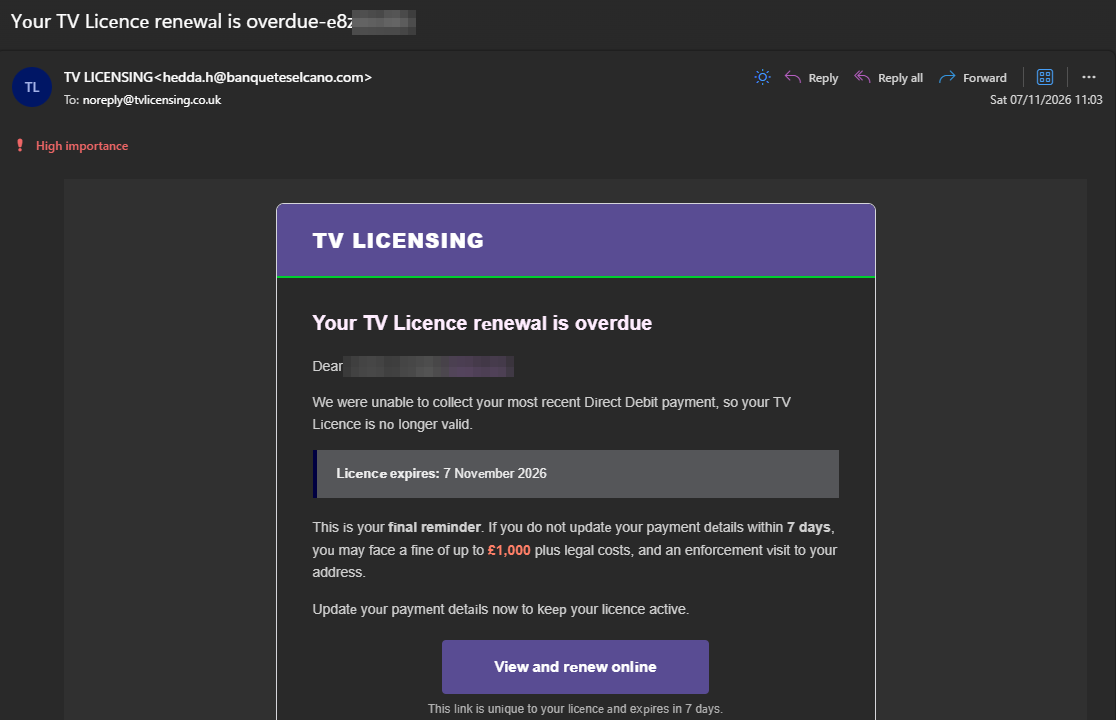
TV Licensing is a good brand to copy. Almost every UK household deals with it, the fine and the enforcement visits are real, and the fee really did rise to £180 in April 2026. The email borrows all of that. It was sent to a personal Outlook address, with no sign it was aimed at anyone in particular.
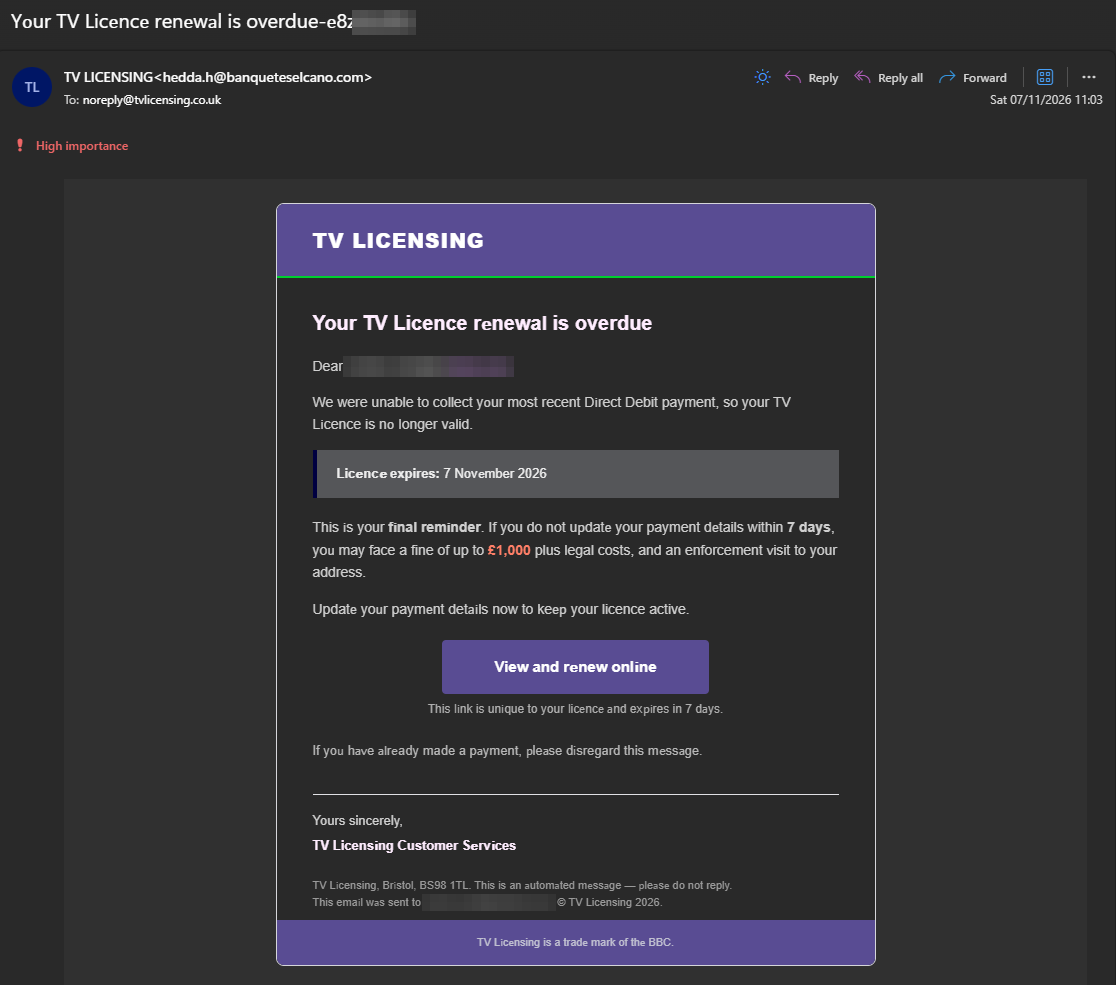
- The sender isn’t TV Licensing. The display name says “TV LICENSING”, but the address is
hedda.h@banqueteselcano[.]com. Real TV Licensing email comes fromtvlicensing[.]co[.]uk. - It wasn’t addressed to you. The To line shows TV Licensing’s own no-reply address. Your address was in the hidden BCC field, the way bulk mail is sent to many people at once.
- The subject ends in a random code. “overdue-e8z…” is a different string on every copy, so no two emails look identical to a spam filter.
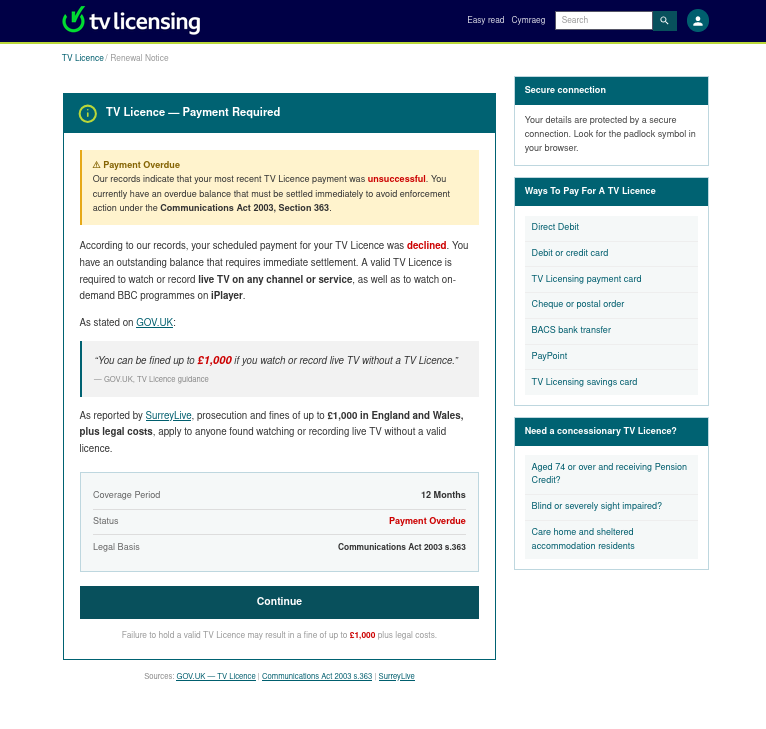
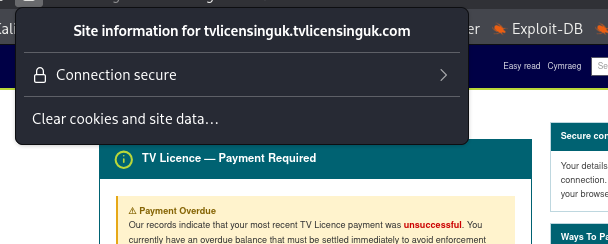
- The padlock proves nothing. The sidebar tells you to look for the padlock, and it’s there. A padlock means the connection is encrypted, not that the site is genuine: this one belongs to
tvlicensinguk.tvlicensinguk[.]com, with a free certificate. - The links go nowhere. Easy read, Cymraeg (Welsh), search, My Account and every footer link are dead. Apart from one link out to GOV.UK, only Continue does anything.
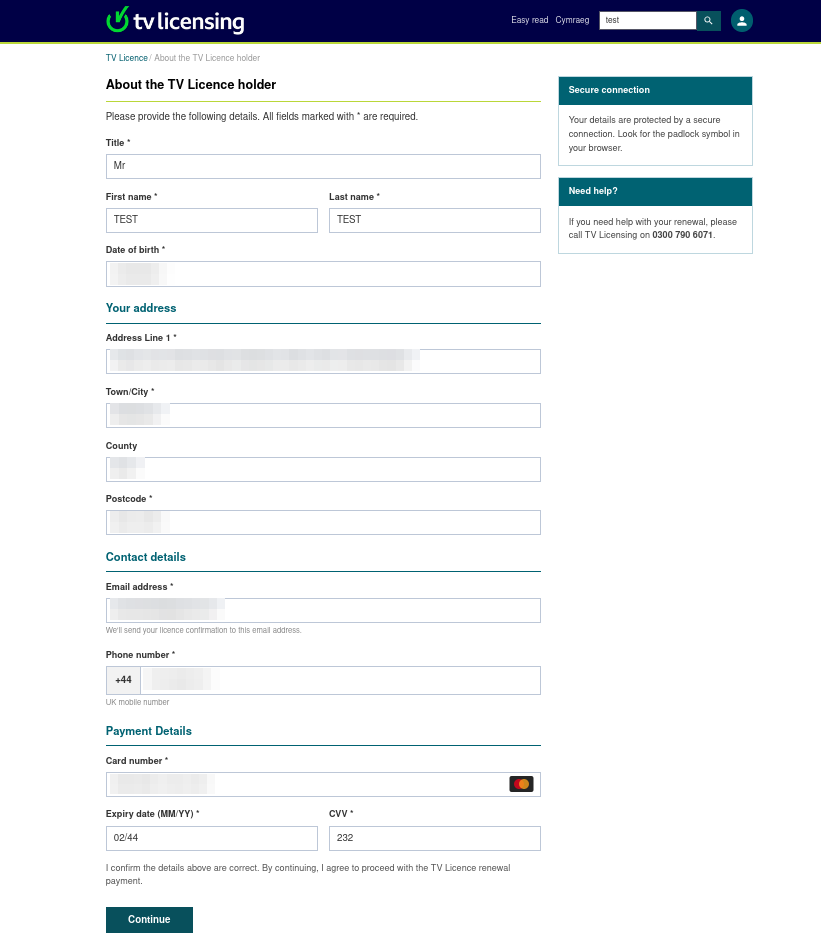
- It wants the whole card up front. Card number, expiry and security code are requested on a “licence holder” form, alongside date of birth, address and phone. A renewal page has no reason to collect your card before the payment step.
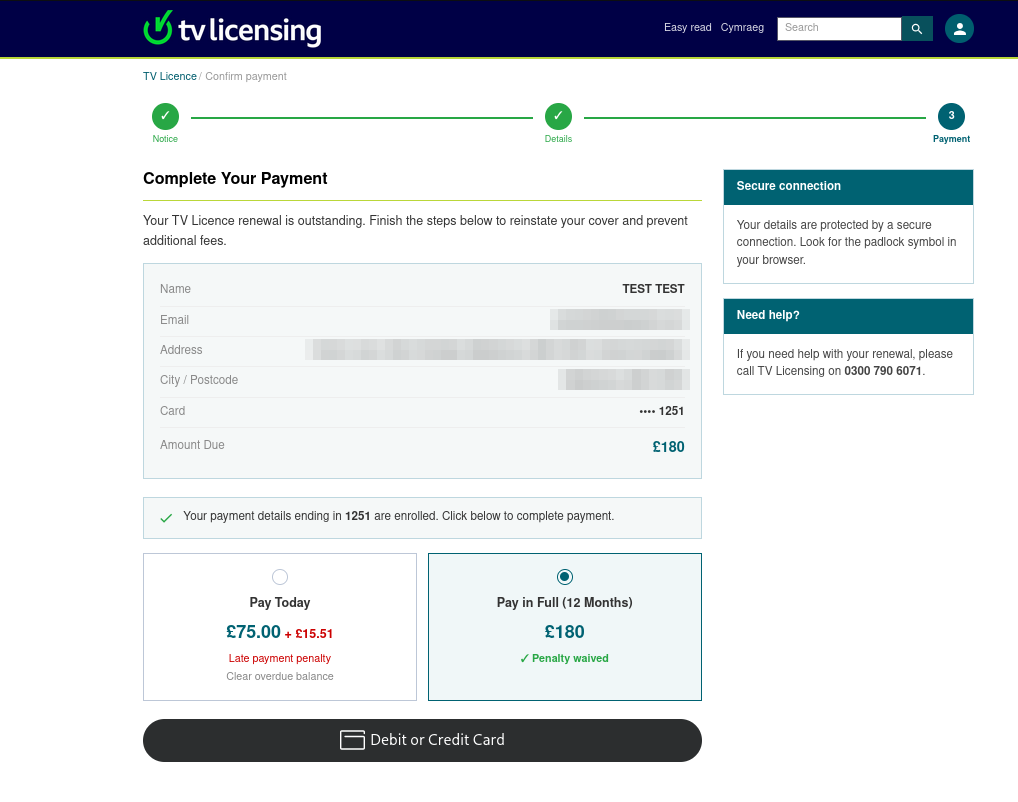
- They already have your card. “Your payment details ending in 1251 are enrolled.” The previous form has already gone to the attackers, whatever happens next.
- The price changes at the button. The page says £180, the real fee. The card form underneath says Pay £180.51.
Headers and authentication
The relevant headers, with the recipient removed:
From: ΤV LICEΝSING <hedda.h@banqueteselcano[.]com>
Reply-To: noreply@banqueteselcano[.]com
To: noreply@tvlicensing[.]co[.]uk
BCC: [redacted]
Subject: Y𝗈ur TV Lic𝖾nc𝖾 ren𝖾w𝖺l is overdue-𝖾8z…
Date: Sat, 7 Nov 2026 03:03:48 -0800
Message-ID: <CAPrq9MO…@mail.gmail[.]com>
List-Unsubscribe: <mailto:hedda.h@banqueteselcano[.]com?subject=unsubscribe>
Importance: high
X-Priority: 1
Received: from 470866942346 named unknown by gmailapi.google[.]com with HTTPREST
Authentication-Results: spf=pass (sender IP is 74.125.227[.]136)
 smtp.mailfrom=banqueteselcano[.]com; dkim=pass (signature was verified)
 header.d=banqueteselcano-com.20260707.gappssmtp[.]com;dmarc=pass
 action=none header.from=banqueteselcano[.]com;compauth=pass reason=100
X-MS-Exchange-Organization-SCL: 5
Reading the Received chain from the bottom up:
| Hop | From | To | Time (UTC) |
|---|---|---|---|
| 1 | Gmail API client 470866942346 (HTTP, not SMTP) |
11:03:48 | |
| 2 | mail-pj2-f8.google[.]com (74.125.227[.]136) |
Microsoft EOP front end | 11:03:50 |
| 3 | EOP | Exchange Online mailbox servers | 11:03:50 to 11:03:52 |
The first hop is the unusual one. The message wasn’t typed into Gmail or handed to an SMTP server. It was submitted to gmailapi.google[.]com over HTTPS by a program. The number in that line is most likely the Google Cloud project behind the sending app. A script using the Gmail API can work through a mailing list from a real Google Workspace mailbox, and every message leaves through Google’s own servers.
That’s why authentication passes.
- SPF passes because
banqueteselcano[.]comauthorises Google’s servers, and the email genuinely came from Google. - DKIM passes with
banqueteselcano-com.20260707.gappssmtp[.]com, Google’s default key for a Workspace domain that hasn’t set up its own. That’s the same pattern as the myGov sample. - DMARC passes. The domain publishes a DMARC record with
p=none, a policy that asks for nothing to be done with failures, and this message didn’t fail anyway. - It dresses as legitimate bulk mail. A
List-Unsubscribeheader, high importance, the brand’s own no-reply address in To and the real recipient in BCC.
This sample doesn’t show whether banqueteselcano[.]com is a compromised business or a domain set up for this. Microsoft filed it to Junk with a spam confidence level (SCL) of 5, on content and reputation rather than authentication.
The letters that aren’t letters. The sender name, subject and body look like plain English, but they aren’t. 97 characters in the plain-text version alone are lookalikes from other parts of Unicode:
| Looks like | Actually is | Count |
|---|---|---|
| e, i, a, o, l, u, p, v | Mathematical sans-serif letters (U+1D5BA–U+1D5CF) |
79 |
| o | Greek small omicron (U+03BF) |
9 |
| T, E, I, N, B | Greek capitals tau, epsilon, iota, nu, beta | 9 |
In the display name, “ΤV LICEΝSING” uses a Greek Τ and a Greek Ν. To a reader it’s identical. To a filter matching “TV LICENSING”, “licence” or “payment”, it’s a different string, and so is every word that contains a swapped letter.
It isn’t flawless. In the copy received, the lookalike letters broke Outlook’s address detection, and it turned the tail of the recipient’s own address into a link to tlook[.]com.
Redirect chain
With Safe Links unwrapped, the button pointed to a Google share link:
hxxps://www.google[.]com/share.google?q=ilcqQi…The chain was followed from an isolated VM behind a VPN, with the browser’s Network tab recording every request.

Google share link. share.google links forward to whatever was shared. Here, a 301 from www.google[.]com sends the browser straight to the kit. The link starts with Google, so it gets past reputation checks and hover-checking.
The kit. hxxps://tvlicensinguk.tvlicensinguk[.]com/?ref=354. The ref value is carried through every hop, most likely a campaign or affiliate number.
A decoy for analysts. The same link behaves differently depending on who asks. In Firefox it returned 200 and the kit. Through Burp Suite’s built-in browser, an intercepting proxy, the kit’s server answered with a 302 to twitter[.]com/?ref=354, which lands on X.

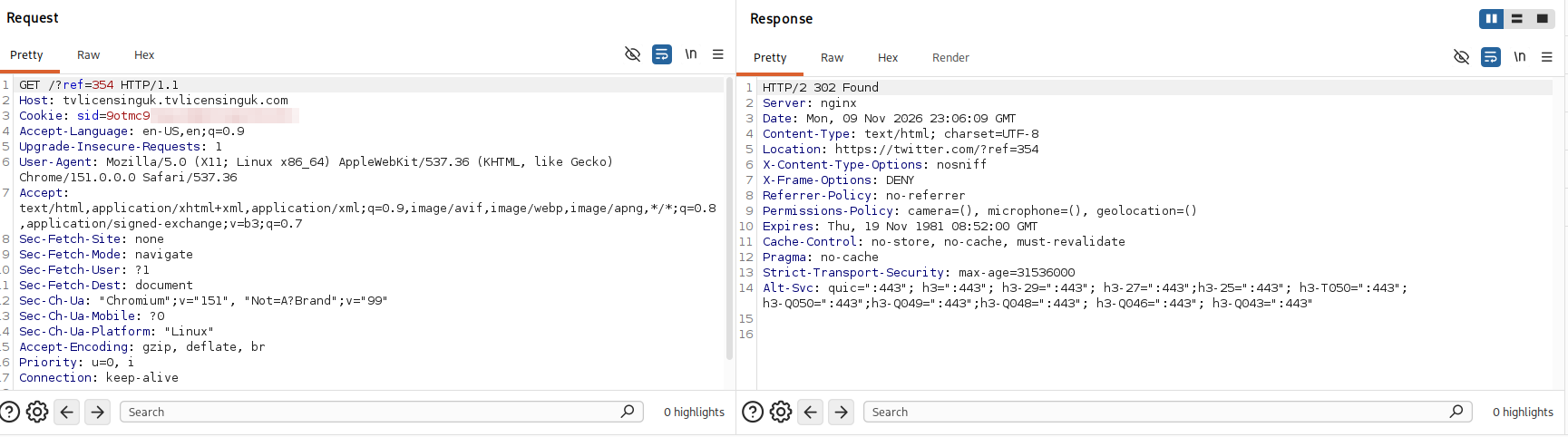
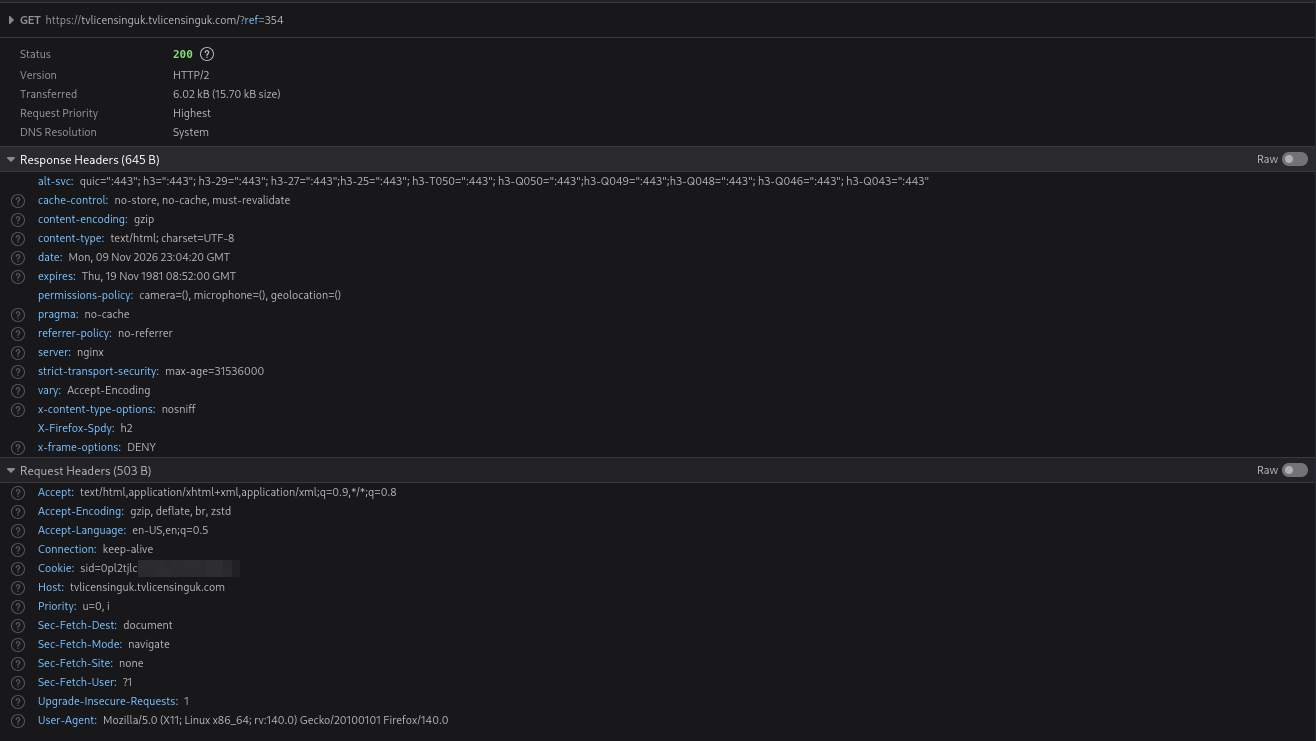
Replaying the request in Burp narrowed it down:
- The verdict sticks to the session. The kit sets a
sidcookie on the first visit. Burp’s session cookie got the decoy every time. Swapping in Firefox’s cookie got the kit. - It’s decided on the first request. With no cookie at all and Firefox’s headers, a fresh session got the kit, even through Burp. So it isn’t detecting Burp’s connection. It judged the first request from Burp’s browser (Chromium on Linux, with Chrome’s client-hint headers) and remembered that judgement.
A scanner flagged on its first visit only ever sees a link that goes to X, which looks harmless. The page also carries a small settings block that includes f: 'GB', which may be a country filter, though the source alone doesn’t confirm it.
The kit: card first, then PayPal
The site is a fairly close copy of TV Licensing’s style: the logo, the sidebar of payment methods, a quote from GOV.UK and a citation of section 363 of the Communications Act 2003, the real offence. The first page, “TV Licence — Payment Required”, leads to a details form, then a payment page.
First, the card. The details form takes name, date of birth, address, email, mobile, and full card number, expiry and security code, and posts them to the kit’s own server. The payment page then arrives with “•••• 1251” already in the HTML the server sends. The card details are stored before any payment is attempted.
Then, the money. The payment page loads a genuine PayPal card checkout. When the card form is submitted, it posts to www.paypal[.]com, not to the kit.
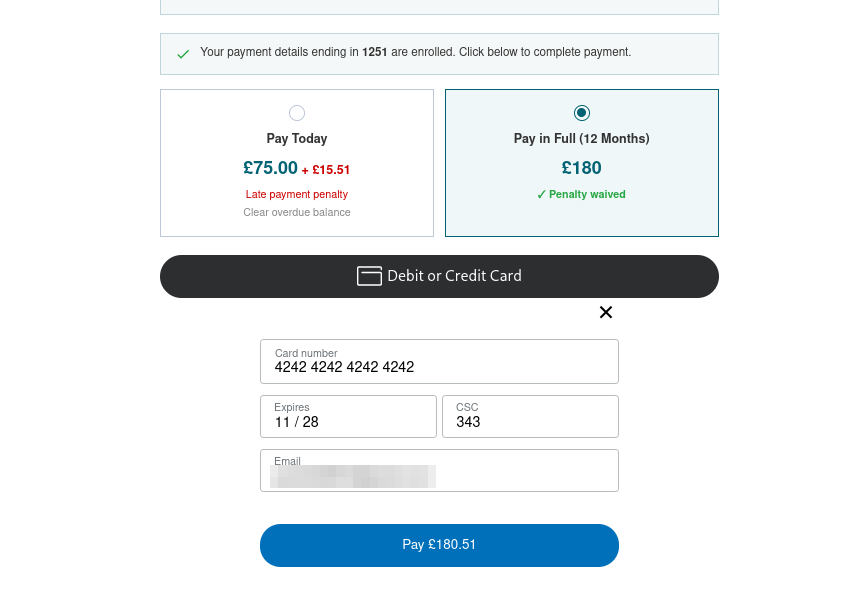

So the victim isn’t only phished, they’re charged: £180.51 into a PayPal merchant account the attackers control. With a test card, PayPal rejected the attempt during validation (OAS_VALIDATION_ERROR at the onboard_user step), before any charge.
The page’s own code shows the rest (trimmed):
var _AMT={"currency":"GBP","symbol":"£","charge":{"plan1":"90.51","plan2":"180.51"},"display":{"plan1_base":"75.00","plan1_fee":"15.51","plan1_total":"90.51","plan2_total":"180"}, ...};
...
fx.open('GET','?get_sdk_url=1',true);
...
// Plan selector — re-render PayPal button on switch (kill eager/cached order, Task F)- The merchant ID is fetched, not written in. The page asks its own server for PayPal’s script URL (
?get_sdk_url=1) after it loads. The original HTML contains no PayPal client ID, so a scanner that only downloads the page never sees which PayPal account is behind it. It only appears once the page runs. - The price is hard-coded to differ. Displayed: £180. Charged: £180.51.
- The payer’s details are quietly changed. The kit pre-fills PayPal’s payer record with what the victim typed, but alters it first. Each time the page loaded, the email gained a random extra digit before the
@, and the mobile number kept its first four digits with the rest randomised. Most likely this stops PayPal’s receipt reaching the victim: that receipt names the merchant who actually took the money, which is the one thing that would tell them who to dispute it with. - The operator gets a report on every attempt. Order created, payment captured, and every decline with PayPal’s reason code are posted back to the kit (
?s=3). After a successful payment, the victim’s real email address is sent back to the kit along with the transaction ID. - Declines keep the victim trying. PayPal’s error codes are mapped to friendly messages, such as “Your card was declined. Please try a different card.”
Like the myGov kit, the developer left a comment in the code: kill eager/cached order, Task F. It reads like a product with a task list.
Payload
None. This is a card harvester and payment scam: no attachment, and nothing runs on the victim’s device beyond the kit’s own page scripts and PayPal’s checkout.
Infrastructure
| Phishing domain | tvlicensinguk.tvlicensinguk[.]com |
| Registered | 27 October 2026, 11 days before the email was sent |
| Registrar | Cloud Yuqu LLC |
| Hosting | 43.163.198[.]64, nginx, served directly rather than behind Cloudflare |
| Sending domain | banqueteselcano[.]com, on Google Workspace |
| Payment | PayPal merchant account, client ID in the IOCs below |
| Last seen live | 9 November 2026, two days after the email |
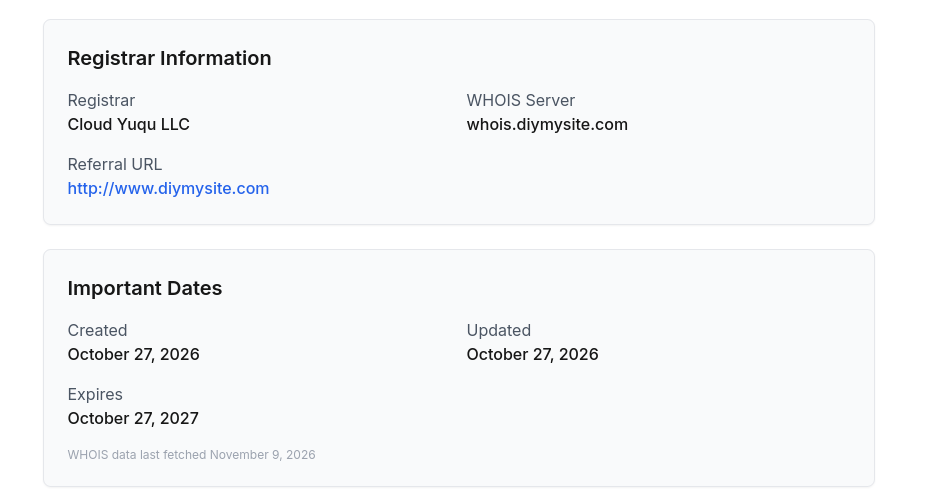
The myGov kit’s domain was used the day it was registered. This one sat for 11 days first, long enough to stop looking brand new to filters that score domain age. The real payment step is the weak point. A PayPal merchant account has an owner PayPal can identify, and closing it stops the money whatever happens to the domain.
IOCs
| Type | Indicator | Note |
|---|---|---|
| Sender address | hedda.h@banqueteselcano[.]com |
Display name uses Greek Τ and Ν |
| Reply-To | noreply@banqueteselcano[.]com |
|
| Sender domain | banqueteselcano[.]com |
Google Workspace |
| DKIM signing domain | banqueteselcano-com.20260707.gappssmtp[.]com |
Google default DKIM |
| Message-ID | CAPrq9MO…@mail.gmail[.]com |
|
| Subject | Your TV Licence renewal is overdue-… |
Lookalike letters, random suffix |
| Sending path | Gmail API client 470866942346 |
Likely the sender’s Google Cloud project |
| Redirect | hxxps://www.google[.]com/share.google?q=ilcqQi… |
Google share link, don’t block google[.]com |
| Phishing URL | hxxps://tvlicensinguk.tvlicensinguk[.]com/?ref=354 |
|
| Phishing domain | tvlicensinguk[.]com |
|
| IP | 43.163.198[.]64 |
|
| Kit endpoints | ?get_sdk_url=1, ?s=3, asset/lib/js/app.js |
Useful for kit hunting |
| PayPal client ID | AabvPi74d2UMatQ7wBdgOFz7UlB_smBTVBgY5_QigvvNnVUz0tohwoWGgLWiy43ukVeX_1TqywTE5wDO |
Merchant account behind the payments |
| Decoy redirect | hxxps://twitter[.]com/?ref=354 |
Served to flagged sessions |
| String | kill eager/cached order, Task F |
In payment page source |
Detection
A brand name in the display name built from non-Latin lookalike letters is rare in legitimate mail, and a share.google link in the same message makes it rarer. A starting point in Defender Advanced Hunting:
EmailEvents
| where Timestamp > ago(7d)
| where SenderDisplayName matches regex @"[\x{0370}-\x{03FF}\x{1D400}-\x{1D7FF}]"
    or Subject matches regex @"[\x{1D400}-\x{1D7FF}]"
| join kind=leftouter (
    EmailUrlInfo
    | where Url has "share.google"
    | project NetworkMessageId, Url
  ) on NetworkMessageId
| project Timestamp, SenderDisplayName, SenderFromAddress, Subject, Url, DeliveryLocation
The Greek range will also match genuine Greek senders, so tune it to your mail. The mathematical letters (U+1D400–U+1D7FF) have almost no place in a real subject line.
Key takeaway
A real payment page doesn’t make a real payment. This kit hands the victim a genuine PayPal checkout, and everything around it is fake. Bills, renewals and fines get paid by typing the organisation’s address yourself, never from a link in an email.